Imminently
Decisively
Turning dense legislation into clear, logical decisions for millions of Australians

I led the design direction for Decisively from proof of concept to first release, responsible for the end-to-end product design including information architecture, interaction design, visual direction, and design system foundations. I also embedded agile methodology and design thinking within Decisively's product development process.
The problem
When someone applies for a government benefit or visa online, someone has to translate thousands of pages of legislation into conditional logic that determines eligibility. Decisively automates that process: a machine learning platform that ingests legislation and lets rule authors build the data models and interview flows behind those decisions.
When we started, Decisively had a bare-bones proof of concept but no production-ready product. Three distinct user types needed to work within the same platform: rule and policy authors (legal professionals building conditional logic), designers (shaping end-user interview experiences), and developers (connecting APIs and implementing interviews).
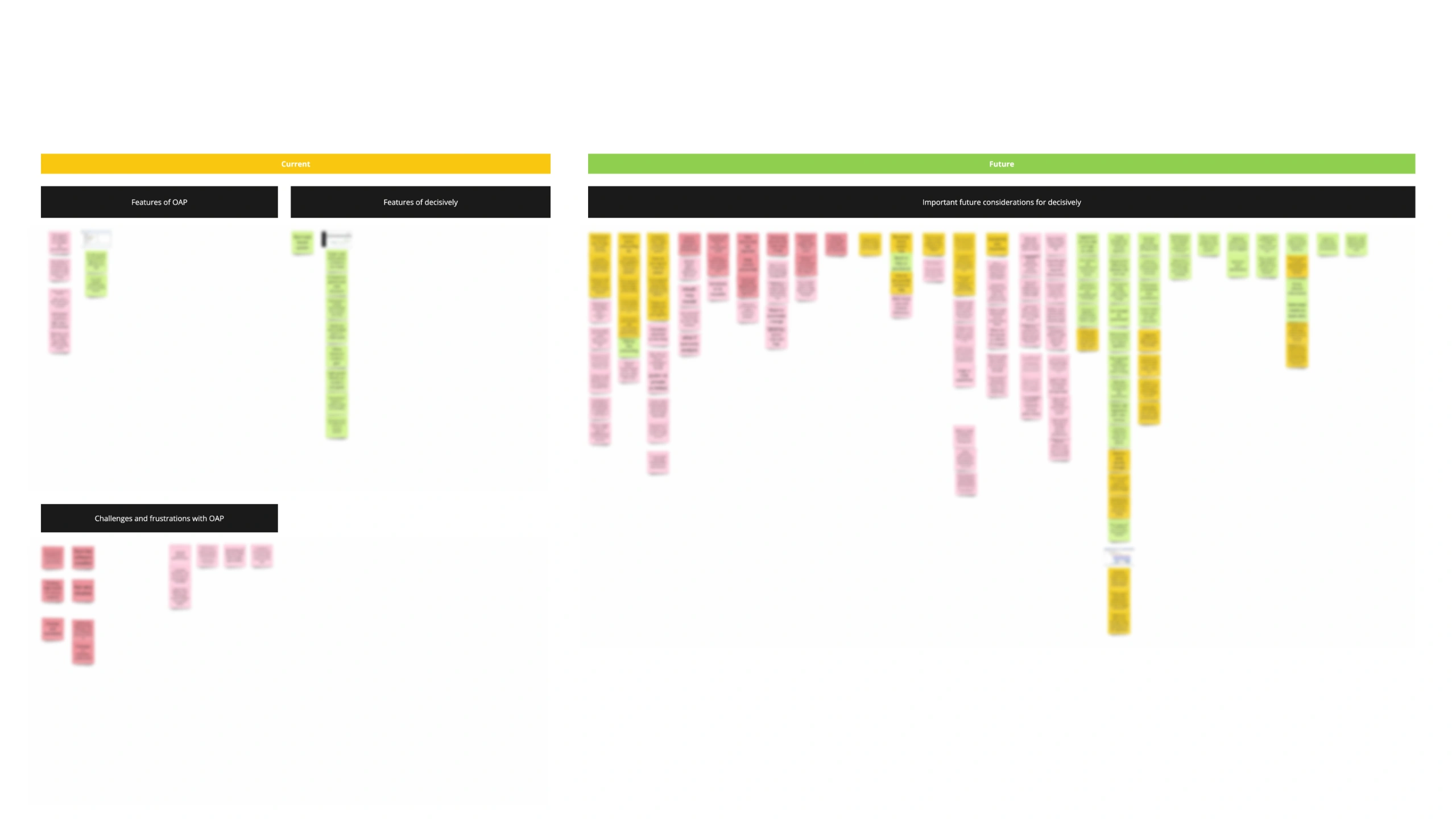
The incumbent tool, Oracle Policy Automation (OPA), was the benchmark our stakeholders were coming from. In discovery workshops, legal professionals walked us through OPA's frustrations: source material and authored rules were tangled together with no traceability, versioning had no visibility into who changed what, graph links were unreadable, syntax was entirely manual, and it required installed software.
The brief: Design a cloud-based platform from the ground up that makes it intuitive for rule authors to ingest legislation, build conditional logic, design interview flows, and validate their work, replacing the manual, fragmented workflows of Oracle Policy Automation.
Research and discovery
We began with discovery workshops covering user groups, job stories, journey maps, and feature story mapping. The most valuable research came from ongoing interviews and workshops with legal professionals and subject matter experts, who demonstrated their current OPA workflows, identified pain points, and later validated our design solutions against those same frustrations.
Three insights shaped the direction:
- Source material and authored rules needed to be fundamentally separate. In OPA, these were entangled, making it impossible to trace a rule back to its legislative origin. This insight shaped the entire authoring architecture.
- User types needed different views but shouldn't be locked in silos. Authors, designers, and developers regularly crossed into each other's territory. Rigid role-based navigation would recreate the context-switching frustration of existing tools.
- Conditional logic errors had real consequences. Rules built in Decisively determine eligibility for government benefits, visas, and essential services. The bar on auditability and validation was far higher than typical SaaS.